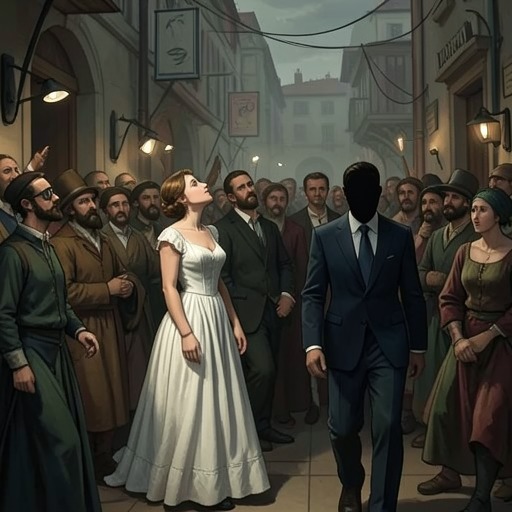
Épine dans le cœur
Cœur de slush“Épine dans le cœur” (“Thorn in the Heart”) names the book’s image for disappointment that does not disappear simply because it seems small. For Billie Fay, summer’s romantic slights take bodily form as thorns lodged in her heart: each one marks a moment of wanting to be chosen, noticed, or already grown, and each sharpens her awareness of Annette’s apparent ease.
The Image and Its Setting
The metaphor enters a summer organized around hope and self-presentation. Before an evening out, Billie Fay puts on her mother’s Dior powder, mascara, and root-beer lip balm in her bedroom, whose adjoining bathroom is her own. The room smells of her perfume, which she associates with tulips, vanilla, and summer—ice cream, sunshine, sandals, grass, and berries. Against that abundance of sensory promise, she hopes the evening will repair the small disappointments that have been planting thorns in her heart.
The image makes romantic disappointment both intimate and physical. Billie Fay does not describe these setbacks as abstract lessons; she gives them names, ranks their severity, and imagines them lodged in a particular place. The first is her largest summer thorn so far, while another is the second largest. That playful accounting does not make the hurt unreal. Instead, it shows how vividly she experiences each slight, even as she tries to arrange and explain it.
Étienne’s Rejection
Étienne, a slide repairman at the water park, becomes the largest thorn. He sprays girls with water from the slides, and they tolerate his teasing; some are later chosen for an after-hours ride on his four-wheeler in the parking lot. Billie Fay’s account of his appeal is concrete: he is tall, sun-browned, loud, and has a skull tattooed on his forearm. His attention to the girls makes being selected seem like a prize.
On a rainy afternoon, Étienne hesitates between Billie Fay and another girl. Earlier, at lunchtime, he had complimented her freckles and the narrowness of her hips in her red swimsuit. Billie Fay takes those remarks as reason to believe he will choose her. Instead, he picks Shannon, who speaks almost entirely English. Billie cries, but the rain hides her tears from everyone around her. She likens the obscured sadness to songs and films, turning an ordinary disappointment into a scene that resembles the romantic dramas through which she imagines love.
The hurt acquires an exact, comic-grotesque scale: Billie Fay says the thorn is as large as a mechanical-pencil lead and planted in the left buttock of her heart. The oddly specific image preserves the sting while refusing solemnity. Her body, humor, and borrowed romantic conventions all become ways of registering a rejection she cannot simply shrug off.
Simon and Annette
The second-largest thorn is Simon, the painter hired to repaint the family’s gazebo. Before Billie Fay’s mother became adolescent again and hurt the family, she had painted the gazebo white each summer. By the previous May its paint was peeling and the structure turning gray, so Billie Fay’s father hired Simon. He arrived on May 3 wearing denim shorts and no shirt, carrying three gallons of paint and brushes of many sizes. He introduced himself at the door and shook Billie Fay’s hand; she gave him her name, but believes he forgot it almost immediately.
Annette soon draws Simon’s attention. She appears in the entrance wearing a small swimsuit with sequins on its backside, and later that afternoon the two kiss on a trampoline behind the large fir trees at the far end of the yard. They continue kissing often. For Billie Fay, this confirms that her sister’s power to attract attention is not limited to parties: Annette seems to shine without trying, while Billie is left writing poems about Simon and Étienne inside pink crayon hearts whose red-crayon mouths are drawn giving kisses.
The contrast is not simply resentment. Billie Fay describes sisterhood as a mixture of passionate love and gentle jealousy, and imagines that, with age, the mixture may become love alone. She hopes to shine as brightly as Annette, whom she regards as perfect, a real woman in body and mind. The thorn image therefore links romantic longing to sibling comparison: the pain of being overlooked grows sharper beside someone who seems effortlessly seen.
Girlhood, Womanhood, and Wish-Making
Billie Fay’s disappointments expose an uncertainty she cannot yet settle. When sad, she becomes a “girl-child”; when no longer sad, she feels almost like a “girl-woman.” The shifting terms make growing up feel less like a clean transition than a state that changes with her mood and circumstances. Her desire to be noticed “like a woman” sits beside the evidence of her youth: pale, youthful nail colors, poems drawn in crayon, and a sister she treats as the measure of adult femininity.
Wish-making gives that desire a ritual form. Billie Fay puts on heavy heart-shaped earrings and wishes to shine more brightly than her beautiful sister, just once. She later appeals to Madame la Vie, asking to be cool and attract attention that evening. The wishes do not remove the thorns already planted; they reveal the hope that one successful evening might counterbalance them. The recurring image holds both parts together: each slight hurts, and Billie Fay continues to imagine that attention and recognition might make the next moment different.